Tserenbat Budragchaa
Traditional Mongolian melodies within the walls of the Hankook House
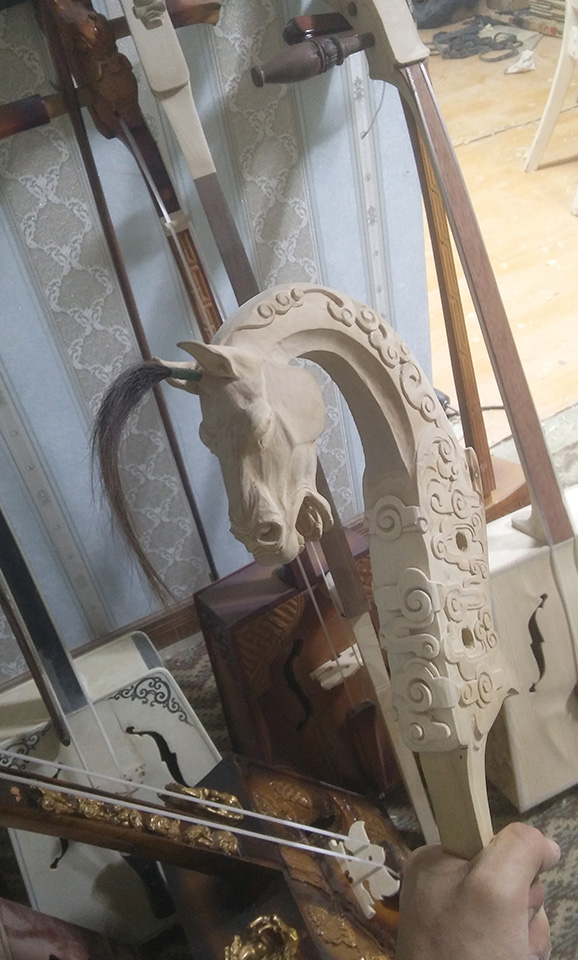
A trapezoidal wooden box with two strings and a bow –yet a true work of art. The “Morin Khuur” is Mongolia’s most important folk instrument and, as well as being the country’s national symbol, it is also on UNESCO’s World Cultural Heritage list. And, we happen to have a colleague who not only plays it with virtuosity, but can also make the “horse-headed fiddle” himself. We spoke to Tserenbat Budragchaa, one of the operators at PMT/Mold, about his unusual hobby.
Tell us a little about yourself. How did you get to know this instrument?
It all goes back to my childhood. In the fourth grade, my grandmother started teaching me how to play the “Morin Khuur”. My mother, meanwhile, was a teacher of vocal singing; so, music and rhythm were in her blood. She showed me old traditional Mongolian songs. I loved to learn from her, but it remained a home activity and I did not continue learning it further, at school.
How did you learn to make the “Morin Khuur” yourself?
In Mongolia, every man is required to spend a year in the army, so I joined the service at the age of 18. It was during this time that I realized how much I missed music. I decided I wanted to take it up more seriously. When I completed one year of service and went back home, I started working in a small instrument factory with the help of my grandmother, where I learned the ins and outs of making a “Morin Khuur”. I did not do the ornate horse-head carving on the neck of the instrument, as there were specialists for that, but I did everything else. I loved this job, but with the birth of my son, I had look for another job.
Can you share some background secrets about the “Morin Khuur”?
What is very interesting about this instrument is that it makes all the difference what kind of wood it is made from. The choice of wood determines its value and how it sounds. Of course, all “Morin Khuurs” can be tuned, but the wood is still the determining factor. We have worked with pine, oak, but also mahogany and ebony. The rarer the wood, the more special the “Morin Khuur” will be –and also the more expensive.
You have been in Hungary only for 3 months, but I understand that in this short period of time you have already played for your colleagues several times. How have they received you?
Yes, I’ve played for them and they always listen with great interest. Most of the time I sing with the accompaniment of the instrument, which also they like; they are fascinated by the technique of the Mongolian throat singing. Despite my recent arrival in Hungary, I feel comfortable here. The weather is very pleasant, especially compared to home. At this time of the year, in Mongolia, it is already very cold and snowing. Hungarian people are kind, patient and understanding with me, it is good to work with them. And, of course, they don’t mind if I take out my “Morin Khuur” in the hostel, during my free time.
Listen to how the “Morin Khuur” sounds!